Detailed Mechanism of Action
AOD-9604 is a modified synthetic peptide fragment corresponding to amino acids 176-191 of human growth hormone (hGH), with a critical tyrosine modification at the N-terminus that alters its biological activity profile. The compound was specifically engineered to isolate and retain the lipolytic (fat-burning) properties of full-length growth hormone while completely eliminating the growth-promoting, IGF-1-elevating, and diabetogenic effects that make exogenous HGH problematic for many applications.
At the molecular level, AOD-9604 interacts with beta-3 adrenergic receptors on the surface of adipocytes (fat cells). This interaction triggers an intracellular signaling cascade that increases cyclic AMP (cAMP) levels within the fat cell, which in turn activates hormone-sensitive lipase (HSL) — the key enzyme responsible for catalyzing the hydrolysis of stored triglycerides into free fatty acids and glycerol. This process, called lipolysis, releases stored fat for use as metabolic fuel. Simultaneously, AOD-9604 inhibits lipogenesis — the metabolic pathway responsible for de novo fatty acid synthesis and new fat formation — creating a dual mechanism that both breaks down existing fat and prevents new fat from being deposited.
What makes AOD-9604 uniquely attractive in the fat-loss peptide landscape is what it does NOT do. Unlike full-length HGH, AOD-9604 does not elevate serum IGF-1 levels, does not impair glucose tolerance, does not disturb blood glucose homeostasis, and does not promote tissue growth. Across six randomized controlled human trials involving over 900 participants, AOD-9604's safety profile was described as "indistinguishable from placebo" — a remarkable statement for any bioactive compound. This makes it one of the safest peptides available for fat metabolism research.
Clinical Evidence
AOD-9604 has been evaluated in multiple human clinical trials, providing a substantial safety database alongside modest but measurable efficacy data. The Phase IIa trial demonstrated statistically significant fat loss in obese subjects over a 12-week treatment period, confirming that the isolated hGH fragment retains meaningful lipolytic activity in humans, not just in preclinical models.
The Phase IIb trial, conducted over 24 weeks with a larger patient population, showed a weight difference of 2.6 kg for the AOD-9604 group versus 0.8 kg for placebo. While this result was directionally positive, it did not achieve statistical significance, and the development program was terminated in 2007. However, it is important to contextualize these results: the trial predated the modern understanding of combination peptide therapy and used AOD-9604 as monotherapy without the complementary compounds that researchers now understand enhance its effects.
From a safety perspective, AOD-9604's clinical track record is exemplary. No serious adverse events were attributed to the compound across all six human clinical trials. No effects on blood sugar, insulin levels, or tissue growth were observed at any dose level. This exceptional safety profile has led to AOD-9604 receiving GRAS (Generally Recognized as Safe) status as a food supplement in Australia, where ongoing investigation also explores its potential applications in osteoarthritis and cartilage repair.
Dosing Protocol
AOD-9604 is administered via daily subcutaneous injection, with the standard research dose ranging from 300 to 500 mcg per day. A conservative starting dose of 250 mcg daily is recommended for the first week to assess individual tolerance before escalating to the full therapeutic range. The timing of administration is critical to AOD-9604's efficacy: the injection should be given in the morning in a completely fasted state, at least 30-60 minutes before the first meal of the day, to maximize fat oxidation during the fasting window.
The preferred injection site is the abdominal subcutaneous fat, at least two inches (5cm) from the navel. Rotate between left and right sides of the abdomen with each injection. The rationale for abdominal injection is consistent subcutaneous absorption and proximity to the target visceral adipose tissue. No loading phase is required — AOD-9604 can be administered at its target dose from the first week if tolerated. Typical protocol cycles run 12-24 weeks depending on the research objectives and metabolic goals.
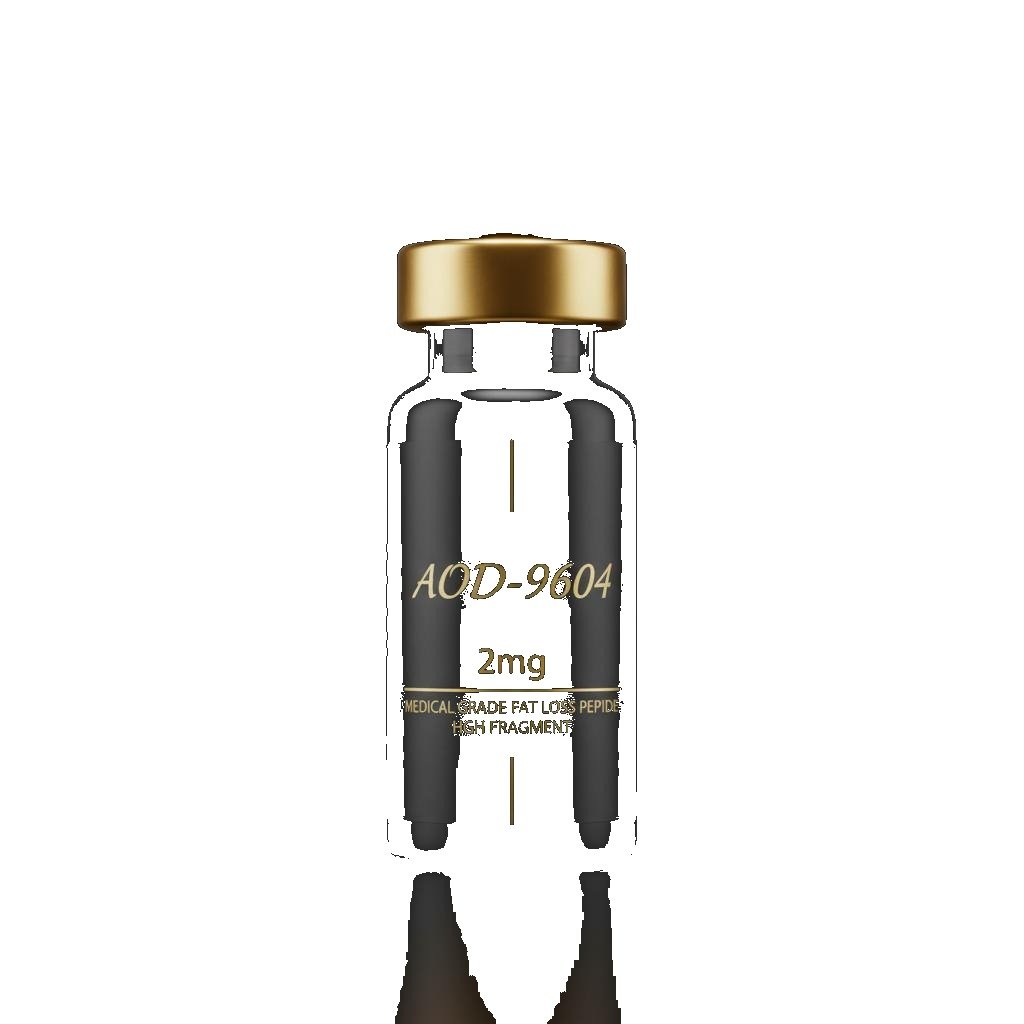
For reconstitution of the 2mg vial, adding 1mL of bacteriostatic water creates a concentration of 2,000 mcg/mL. At a 500mcg daily dose, this provides 4 days of supply per vial (0.25mL or 25 units on a U-100 insulin syringe per dose). AOD-9604 is commonly combined with other fat-loss peptides such as Tesamorelin or CJC-1295 for synergistic effects, and is also stacked with BPC-157 for combined fat loss and healing research protocols. For research purposes only.
Side Effects & Safety
AOD-9604 possesses one of the most favorable safety profiles of any research peptide, consistently described in clinical literature as having a safety profile "indistinguishable from placebo." Across six randomized controlled human trials enrolling over 900 participants, no significant adverse effects on blood sugar, insulin levels, IGF-1 levels, or tissue growth were detected. This is a direct result of the compound's design: by isolating only the lipolytic region (amino acids 176-191) of growth hormone, the growth-promoting and metabolic-disrupting effects of full-length HGH are completely absent.
Mild injection site reactions (redness, minor irritation) may occur, as with any subcutaneous injection protocol. Headache has been reported uncommonly. No antibody formation against AOD-9604 was detected in clinical trials, suggesting good immunological tolerability. The compound does not cause the joint pain, fluid retention, carpal tunnel syndrome, or insulin resistance that are common side effects of exogenous growth hormone therapy.
The primary limitation of AOD-9604 is efficacy rather than safety — while it reliably stimulates lipolysis, the magnitude of weight loss in clinical trials was modest compared to modern incretin-based therapies like tirzepatide or retatrutide. It is best positioned as a component of combination protocols or for subjects who specifically need targeted fat metabolism support without the hormonal and metabolic disruptions associated with more potent compounds. This product is for research purposes only.
Storage & Reconstitution
Store the lyophilized AOD-9604 2mg vial at 2-8°C (36-46°F) before reconstitution. The sealed vial may be stored frozen at -20°C for long-term preservation. Protect from direct light and moisture. The lyophilized peptide maintains stability when the vial seal is intact, though prompt refrigeration upon receipt is always recommended.
Reconstitute using bacteriostatic water (0.9% benzyl alcohol). Swab both vial stoppers with alcohol and let dry. Using a 21-25 gauge reconstitution needle, draw the desired BAC water volume. Inject slowly into the peptide vial, directing the stream down the glass wall. Do not shake — roll gently between palms until dissolved. Solution should be clear and colorless. For the 2mg vial, adding 1mL BAC water yields 2,000 mcg/mL; at 500mcg per dose, each injection uses 0.25mL (25 units on a U-100 insulin syringe).
After reconstitution, store at 2-8°C and use within 28 days. Never freeze reconstituted solution. In the UAE, where temperatures regularly exceed 45°C in summer, cold chain management is essential for all peptide products. Reconstituted AOD-9604 is particularly sensitive to heat — never leave outside refrigeration during UAE summers. Use insulated transport containers with cold packs and verify delivery packaging integrity. Store vials upright in the refrigerator, away from direct light.
Frequently Asked Questions
What is AOD-9604 and how does it work?
AOD-9604 is a modified fragment of human growth hormone (amino acids 176-191) that retains HGH's fat-reducing activity without its growth-promoting or diabetogenic effects. It stimulates lipolysis by activating beta-3 adrenergic receptors on fat cells and simultaneously inhibits lipogenesis (new fat formation). Its safety profile was described as "indistinguishable from placebo" across six human clinical trials.
What are the side effects of AOD-9604?
AOD-9604 has an exceptionally favorable safety profile. No significant adverse effects on blood sugar, insulin levels, or tissue growth were reported in clinical studies involving 900+ participants. Mild injection site reactions and uncommon headache are the only reported side effects. It does not cause the joint pain, fluid retention, or insulin resistance associated with full-length HGH.
How should AOD-9604 be administered?
Administer 250-500mcg daily via subcutaneous injection in the abdomen, first thing in the morning on an empty stomach, 30-60 minutes before eating. This fasted-state timing maximizes fat oxidation. No loading phase is needed. Typical research cycles run 12-24 weeks.
Can AOD-9604 be combined with other peptides?
Yes, AOD-9604 is commonly combined with Tesamorelin or CJC-1295 for synergistic fat-loss effects. It is also frequently stacked with BPC-157 for combined fat reduction and tissue healing protocols. Its clean safety profile makes it one of the most combination-friendly peptides available.
Does AOD-9604 affect blood sugar or IGF-1 levels?
No. This is one of AOD-9604's key advantages. Unlike full-length HGH, it does not elevate IGF-1 levels, does not impair glucose tolerance, and does not affect blood sugar homeostasis. This has been confirmed across multiple human clinical trials.
Disclaimer: This product is sold for laboratory research purposes only. Not for human consumption. All information provided is for educational purposes and does not constitute medical advice. Consult a qualified healthcare provider before starting any peptide protocol.